
Gutter Repair on Long Island: Costs, Common Problems & When to Call a Pro (2026)
By Danny Marchetti, Founder & Lead Installer at LI Gutter Service.
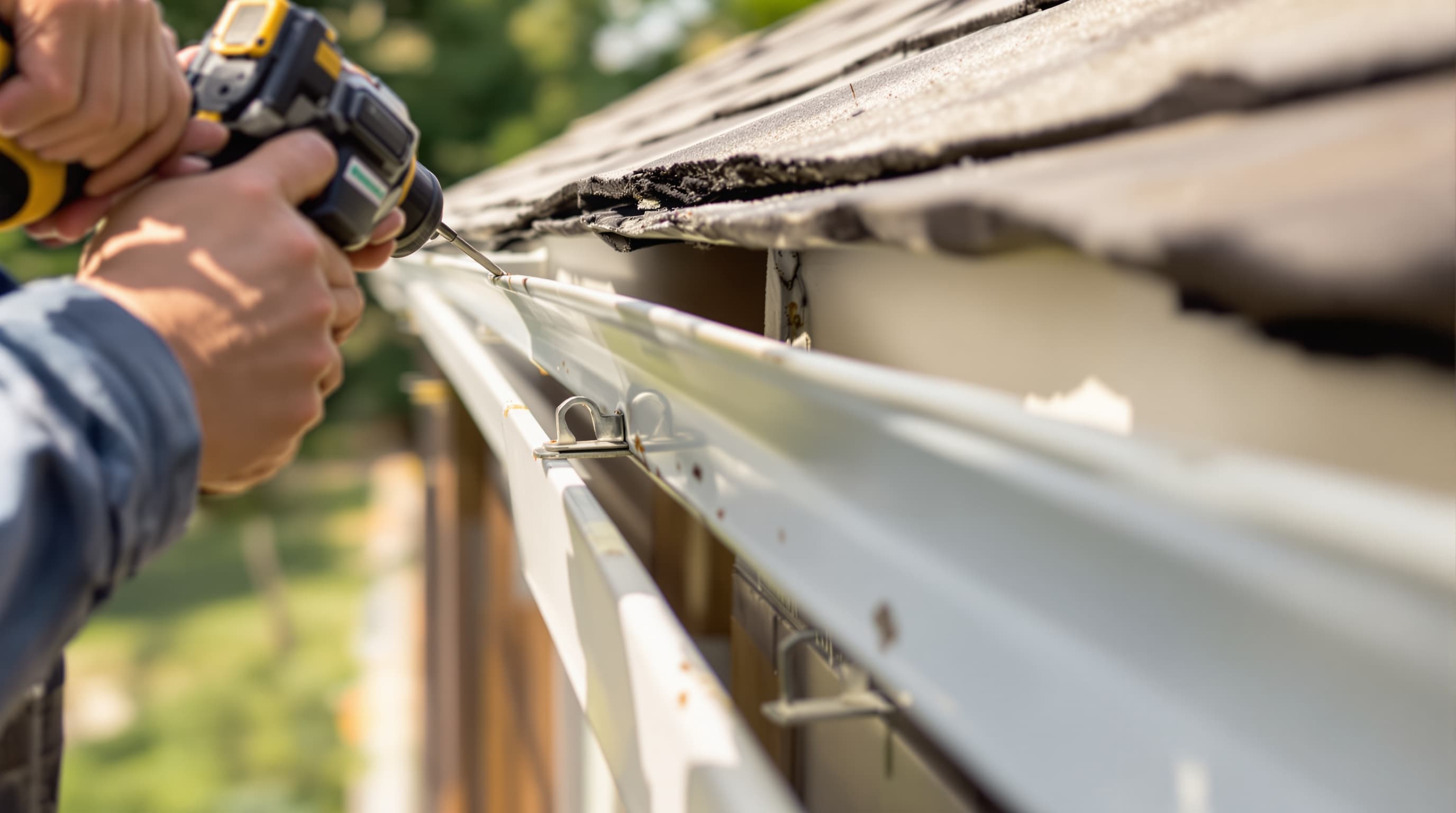
Most Long Island homeowners don't think about gutter repair until water is pouring over the side during a nor'easter or a visible sag catches their eye from the driveway. By that point, the problem has usually been developing for months — sometimes years. A leaking corner seam doesn't announce itself. A pitch problem doesn't make noise. What it does is quietly saturate your fascia, pool against your foundation, and set up the conditions for a basement water event that costs 10x what the gutter repair would have.
This guide covers the most common gutter repair problems we see across Nassau and Suffolk counties, what each repair actually costs, how to decide between repair and full replacement, and what to look for when hiring a gutter repair contractor on Long Island. We've completed over 3,200 gutter jobs since 2014 — a significant portion of those are repairs, not installations. Here's what we know.
Signs you need gutter repair on Long Island
The tricky thing about gutter damage is that most of it isn't visible from ground level. You notice the symptoms — water pooling near the foundation, paint peeling on the fascia, staining on the siding — but the root cause is 20 feet up. Here are the tells that mean you're past cleaning and into repair territory.
Water overflowing from the middle of a run during moderate rain. This almost always means a sag or pitch failure. The gutter is holding water instead of moving it toward the downspout. A single sag point can cause overflow across a 10-foot section.
Dripping at corners or end caps. Corners are the highest-stress point in a gutter system. When the butyl sealant fails — typically at year 12-18 on cheap caulk, year 20-25 on quality butyl — water drips directly behind the gutter and saturates the fascia. One dripping corner is a straightforward repair. Three or more means the sealant across the system is at end-of-life.
Visible gaps between the gutter and the fascia board. When hangers pull loose — especially the old spike-and-ferrule systems common on Long Island homes built in the 1950s through 1980s — the gutter tilts away from the house. You'll see daylight between the back of the gutter and the fascia. Water pours behind instead of into the gutter.
Downspout separation or detachment. Downspout elbows pop loose when ice pushes them apart in winter or when debris backs up and creates weight. A disconnected downspout means the gutter is draining onto your siding or foundation instead of away from it.
Rust streaks on siding or brown water stains on foundation walls. If your home has galvanized steel gutters (common on pre-1990 Long Island homes), rust streaks mean the galvanizing has worn through and the gutter body itself is corroding. Aluminum gutters don't rust, but they can develop pinhole leaks from corrosion where standing water sits for extended periods.
Common gutter problems specific to Long Island
Long Island's climate, housing stock, and tree coverage create a specific set of gutter problems that differ from the generic advice you'll find online. Our crews see these issues week after week across Nassau and Suffolk.
Ice dam damage from freeze-thaw cycles. Long Island sits right in the transition zone where temperatures swing above and below freezing repeatedly from December through March. Ice forms in gutters, expands, lifts gutter sections off hangers, and pries open sealed corners. A single bad winter can damage multiple runs. The Nor'easters of 2024-2025 caused widespread gutter damage across the South Shore that homeowners are still discovering.
Heavy debris loads from mature hardwood canopy. North Shore communities like Oyster Bay, Cold Spring Harbor, and Port Washington have massive mature oaks and maples. The debris load on gutters in these areas is 3-4x what a newer subdivision in central Nassau experiences. This weight, combined with trapped moisture, accelerates hanger failure and creates conditions for sagging.
Salt air corrosion in coastal communities. Homes within a mile of the South Shore — Long Beach, Point Lookout, Jones Beach area, Fire Island-adjacent — deal with salt-laden air that accelerates fastener corrosion. We see hanger screws corrode faster on these homes, and steel gutters fail years earlier than the same product installed 10 miles inland.
Foundation settling and fascia movement. Many Long Island homes are built on glacial till and clay soils that shift seasonally. As foundations settle and fascia boards move with the structure, gutter pitch changes. A gutter system installed perfectly level 15 years ago may now have dead spots where water pools because the house itself has moved a quarter inch.
Nor'easter wind damage. Exposed gutter runs on the south and east faces of Long Island homes take the brunt of coastal storm winds. We repair more torn and detached gutter sections after nor'easters than any other single cause.
Gutter repair cost on Long Island: what each fix actually runs
Gutter repair pricing on Long Island depends on the type of repair, accessibility (one-story vs. two-story), and whether fascia damage is involved. Here are the real ranges we quote — not national averages from other markets.
Leak sealing at corners and end caps: $150-$400. This involves removing old sealant, cleaning the joint to bare metal, applying fresh butyl sealant (not silicone — silicone fails in gutter applications within 2-3 years), and confirming the seal with a water test. Price varies by how many corners need attention and whether the end cap needs resetting.
Sag repair and hanger replacement: $150-$350 per section. A sagging section needs the old hangers removed, the gutter re-pitched to proper slope (1/4 inch per 10 feet toward the downspout), and new hidden hangers installed at 24-inch spacing. If the fascia behind the sag is soft, fascia repair adds to the cost.
Section replacement: $300-$800. When a 10-20 foot section is damaged beyond repair — crushed by a fallen branch, torn off by ice, or corroded through — we cut out the damaged section and splice in new seamless aluminum. This requires a portable forming machine on-site to match the profile exactly. Splice joints get double-sealed with butyl and are as reliable as the original seamless run.
Downspout repair or replacement: $100-$300. Includes re-attaching separated elbows, replacing crushed sections, re-securing wall brackets, and confirming discharge direction away from the foundation.
Full gutter repair (multiple issues across the system): $500-$2,000. When a home needs leak sealing at 3-4 corners, hanger replacement across multiple runs, a section replacement, and downspout work, the job becomes a comprehensive repair visit. This is the price range for a half-day to full-day repair job where the crew addresses everything at once rather than making repeat visits.
Fascia repair (when needed alongside gutter repair): $180-$450 per 4-16 foot section. Rotten fascia is found behind approximately 30% of gutter repairs on Long Island. The fascia must be replaced before the gutter can be properly re-attached — you cannot anchor a hanger screw into soft, water-damaged wood. This is treated as a necessary prerequisite, not an upsell.
Gutter repair vs. replacement: making the right call
The repair-vs-replace decision has a clear tipping point: when repair costs exceed 30-40% of full replacement cost, replacement is the better investment. On a typical Long Island home where full seamless gutter replacement runs $1,800-$3,200, that tipping point is roughly $600-$1,200 in repairs.
Repair makes sense when the problem is isolated — one leaking corner, one sagging section, a single detached downspout. The rest of the system is sound, the aluminum is in good shape, and the hangers are holding. A $200-$400 repair on a 15-year-old system that has another 15-20 years of life in it is money well spent.
Replacement makes sense when you're seeing failures across multiple runs — three or more leaking corners, sags in multiple sections, multiple hanger failures, widespread sealant deterioration. At that point, the system is aging out uniformly, and fixing one spot just means the next spot fails in six months. You end up spending replacement money over two years of repeat repairs.
Age matters too. If your gutters are 25+ years old and you're calling for a second repair in two years, the math strongly favors replacement. New seamless aluminum on hidden hangers every 24 inches, with fresh butyl-sealed corners and properly sized downspouts, resets the clock for 30-40 years. A repair on a 25-year-old system buys you 2-5 years at best.
We'll tell you honestly which way the math goes. About 40% of repair calls end with a recommendation for full or partial replacement — and we explain why with the numbers in front of you. If repair is the right call, we say so. If replacement makes more sense, we show you the comparison.
When to call a pro (vs. DIY gutter repair)
Some gutter repairs are genuinely DIY-able on a single-story home if you're comfortable on a ladder. Re-attaching a loose downspout elbow, clearing a clog at the downspout outlet, or applying a temporary patch with gutter sealant — these are manageable weekend tasks.
Everything else should be professional. Re-pitching a gutter run requires a level, knowledge of proper slope, and the ability to remove and reset hidden hangers while standing on a ladder 15-25 feet up. Seam sealing requires proper surface prep and butyl application technique — the YouTube version with a tube of silicone caulk fails within one season. Section replacement requires an on-site forming machine to match the existing profile exactly.
Two-story gutter repair is categorically not a DIY job. The typical Long Island colonial puts the gutter line at 22-24 feet. Extension ladder work at that height, while holding tools and manipulating gutter sections, is how the majority of residential fall injuries happen in our area. The $300-$500 cost of a professional repair is trivial compared to the ER visit.
If you're seeing any of the signs described above — overflow, dripping corners, visible sags, or foundation moisture — call a dedicated gutter company for an assessment. At LI Gutter Service, assessments are free, honest, and come with a written quote. Call (516) 529-6634 or request a visit online. Danny or Kyle will be on your roof within a few days.
Best time of year for gutter repair on Long Island
The ideal windows for gutter repair on Long Island are early spring (March-April) and early fall (September-October). Here's the reasoning for each season and why timing matters more than most homeowners realize.
Early spring repair catches winter damage before spring rains arrive. Ice dam damage from January and February is fresh and visible. Sealant adhesion is good once temperatures are consistently above 40°F. And spring is when oak pollen and debris start flowing — if your gutters have compromised seams or pitch problems, the pollen paste will make them worse.
Early fall repair gets your system ready for the heaviest debris season and the freeze cycle. November leaf drop plus December ice is the one-two punch that finishes off damaged gutters. A gutter that's "mostly fine" in September will be overflowing in November and ice-damaged in January. Repairing in September gives you a clean, properly pitched system heading into the worst quarter.
Summer repair is fine but demand is lower (most homeowners aren't thinking about gutters in July) so lead times are shorter — sometimes same-week scheduling. Winter repair is possible but limited by temperature requirements for sealant cure and by crew safety on icy ladders. We don't do repair work when temperatures are below 35°F or when ice is present on the roofline.
The worst time to call is mid-November through December — right after leaf drop when everyone suddenly notices their gutters are failing. Lead times spike to 2-3 weeks. If you know your gutters have issues, September is the month to schedule.
What to look for in a gutter repair contractor on Long Island
Gutter repair is one of the trades with the lowest barrier to entry, which means Long Island has no shortage of handymen and side-job contractors offering gutter work. Some are fine. Many are not. Here's how to filter.
Look for a dedicated gutter company, not a general handyman or roofer doing gutters on the side. A company that installs, repairs, and cleans gutters as its primary trade will have the portable forming machine for section replacements, the proper sealants and hanger inventory on the truck, and the experience to diagnose root causes rather than just patching symptoms.
Verify licensing. New York State requires a Home Improvement Contractor (HIC) license for any residential work over $500. Nassau and Suffolk counties have their own home improvement licensing on top of the state requirement. Ask for the license number and verify it. Any legitimate contractor will have it printed on their quote.
Confirm insurance. General liability ($1M minimum, $2M preferred) and workers' compensation are non-negotiable. If a worker falls off your ladder and doesn't have workers' comp, you are potentially liable. Ask for a certificate of insurance, not just a verbal confirmation.
Check Google reviews — but check the right things. Total review count matters more than perfect rating. A gutter company with 200+ reviews and a 4.8 rating is substantially more reliable than one with 12 reviews and a 5.0. Read the negative reviews specifically — how the company responded tells you more than any positive review.
Get a written quote with line items. "Gutter repair — $450" is not a quote. A proper repair quote specifies: what's being repaired (which runs, which corners, which downspouts), what materials are being used (sealant type, hanger type, aluminum gauge for replacements), what the warranty covers, and what's NOT included (fascia repair, painting, etc.).
At LI Gutter Service, every repair quote includes our NY HIC license (HIC-0783421), proof of $2M General Liability insurance with workers' comp, itemized repair scope, and a clear recommendation on whether repair or replacement makes more financial sense. We've been doing this since 2014 and have 214+ Google reviews at 4.9 stars.
Frequently asked questions about gutter repair on Long Island
How much does gutter repair cost on Long Island? Most single-issue repairs (one leaking corner, one sagging section, one downspout reattachment) run $150-$400. Multi-issue repairs that address problems across the system run $500-$2,000. Section replacement where damaged gutter is cut out and new seamless aluminum is spliced in runs $300-$800 per section.
Can leaking gutters be repaired or do they need replacement? Most leaking gutters can be repaired. Corner and end-cap leaks are fixed by removing old sealant and applying fresh butyl. Pinhole leaks in aluminum are patched with gutter-specific sealant. The repair-vs-replace tipping point is when repair costs exceed 30-40% of full replacement — typically around $600-$1,200 on a Long Island home.
How long does a gutter repair take? A single-issue repair (one corner, one sag) takes 1-2 hours. A comprehensive multi-issue repair takes a half-day to full day. Section replacement adds time because the crew forms new aluminum on-site to match the existing profile.
What causes gutters to sag? Hanger failure is the primary cause. Old spike-and-ferrule hangers loosen over time as the spike wallows out of the fascia. Debris accumulation adds weight that accelerates the process. Ice loading in winter pushes hangers past their rated capacity. On Long Island, homes with heavy tree cover and the original 1970s-1980s hanger systems are the most common sag repairs we see.
Should I repair gutters before selling my house? Yes. Visibly damaged gutters are flagged on virtually every home inspection on Long Island and give buyers negotiating leverage disproportionate to the actual repair cost. A $300 gutter repair eliminates a line item that could cost you $1,500-$3,000 in buyer credit requests.
Do gutter repairs come with a warranty? At LI Gutter Service, all repairs carry a workmanship warranty. Sealant work is warranted for 5 years. Hanger and section replacements are warranted for the life of the material (30+ years on aluminum). We put the warranty terms in writing on the repair invoice.
Can I repair gutters myself? Minor work like re-attaching a downspout elbow or applying temporary sealant is DIY-able on a single-story home. Any work on a two-story home, any work involving re-pitching or hanger replacement, and any section replacement should be done by a professional crew with proper ladder and safety equipment.
How do I know if my fascia is damaged behind the gutters? Signs of fascia damage include: paint peeling or blistering on the fascia face, visible softness or darkening at the gutter line, gutters that pull away from the house even after hanger tightening, and a musty or damp smell near the eave. A gutter repair contractor should probe the fascia during any repair assessment.
What's the difference between gutter repair and gutter patching? A patch is a temporary measure — sealant or tape applied over a hole or crack without addressing root cause. A proper repair addresses the underlying failure (hanger replacement for sags, full seam re-sealing for leaks, section replacement for structural damage). Patches buy months; repairs buy years.
How often should gutters be inspected for repair needs? Twice a year — once after winter (to catch ice damage and sealant failures) and once after fall leaf season (to catch debris-related sags and clogs). Homes with heavy tree cover or gutters older than 20 years should add a mid-summer check.
Free quote in one visit
Ready for a firm number on your home?
Pick up the phone or send us the details. We'll respond same-day, Monday through Saturday.
- Free, no-pressure written estimate
- Licensed, insured, family-run since 2014
- Seamless gutters formed on your driveway
- Same crew from measure to cleanup