
Gutter Guards on Long Island: Which Type Actually Works (And Which to Skip)
By Danny Marchetti, Founder & Lead Installer at LI Gutter Service.
Long Island throws everything at gutters: oak pollen in April that turns into a thick paste inside foam inserts, sycamore samaras that slip through reverse-curve guards, pine needles from North Shore plantings that bypass every screen design. Whatever gutter guard manufacturer used footage from the Pacific Northwest is not describing your problem.
We install and service gutters in Nassau and Suffolk year-round. This is what we've seen hold up and what we've watched homeowners pull out in frustration two summers after install.
Why most gutter guards fail here specifically
The Long Island debris mix is punishing in a specific way. Oak pollen arrives in late April as fine yellow dust — it washes through large-opening screens and turns into dense slurry inside foam and brush inserts. One oak tree can deposit enough pollen to fill a 40-foot gutter run with compacted material by mid-May.
Sycamore samaras (the winged seed pods) are roughly 1.5 inches long and enter reverse-curve guards right at the lip. They decompose slowly and create weed-germination beds directly in the trough. Maple samaras do the same.
Pine needles from the white pines common on the North Shore are long and narrow — they slip through any opening wider than about 1.5mm. Most mass-market plastic screens have openings of 3-6mm.
If you buy a guard designed for leaves, it won't solve the Long Island pollen and needle problem. That's why we see so many first-generation guard installs get ripped out here.
The three guard types and our verdict
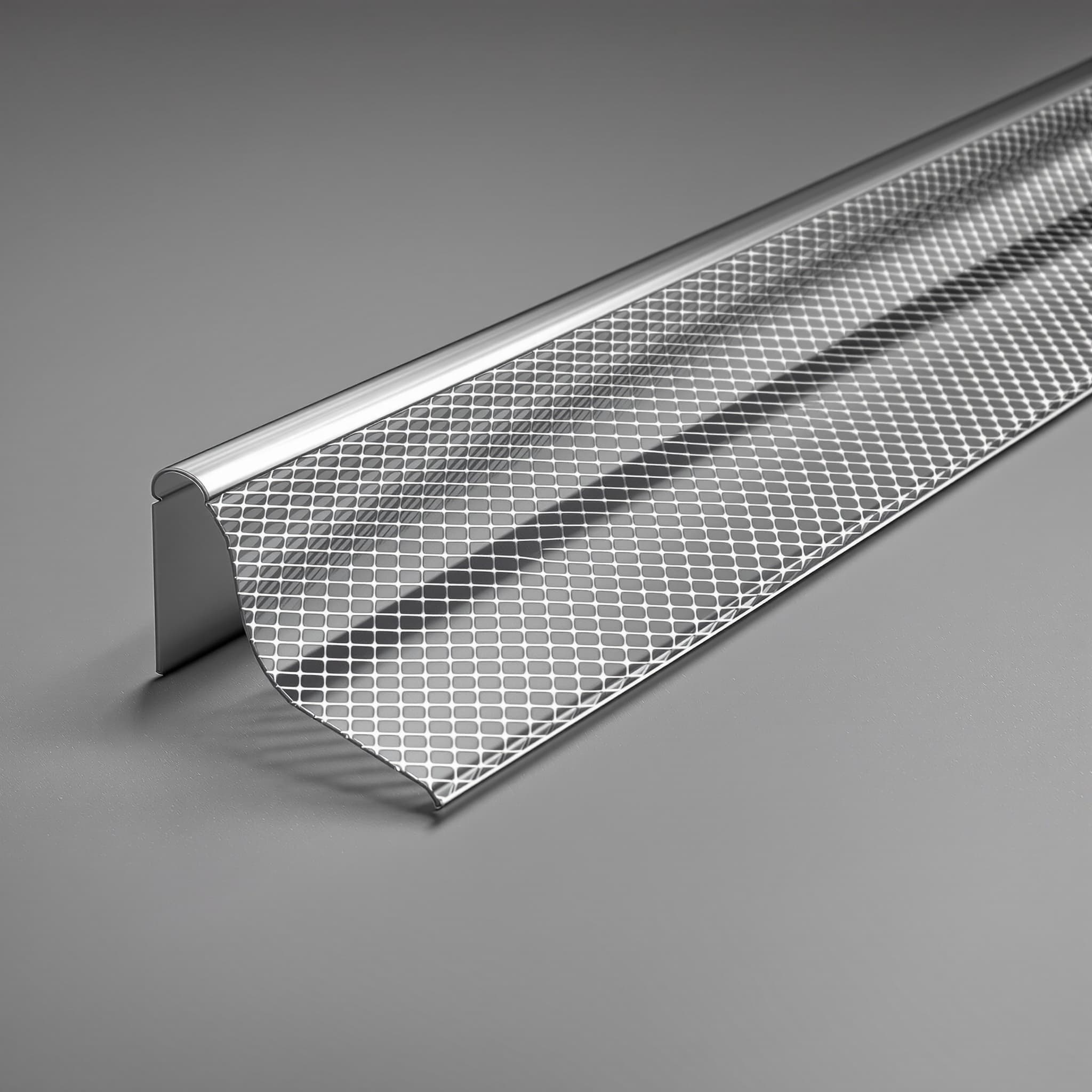
Stainless steel micromesh (opening size 50-100 microns): The only guard we recommend without reservation. The opening is too fine for pollen, needles, or samaras to pass through. Water sheets over the surface and drops in; everything else blows off or slides over the edge. Premium brands (Mastershield, Leafguard Micromesh, LeafFilter) hold up 20+ years. The catch: they need professional installation to seat correctly, and you pay for it.
Reverse-curve solid guards: Work well on pure leaf debris and look clean from the ground. On Long Island homes with oak or sycamore, the lip catches the narrow samaras exactly where they shouldn't land. We get calls every spring about this. If your yard has no oak, maple, or sycamore and you're mainly fighting large leaves, reverse-curve is a reasonable middle option. $15-22 per linear foot installed.
Foam and brush inserts: Do not buy these. They filter debris into the foam itself, requiring annual removal and cleaning to avoid mold and pest habitat. Oak pollen saturates them in the first season. In our service experience, 90% of foam-insert customers are pulling them out within 18-24 months. Any price is too high for something you'll remove.
Plastic snap-on screens: Better than nothing for large leaves, poor against pollen and needles, crack within 2-3 years in Long Island freeze/thaw cycles. Worth it only as a very short-term stopgap.
Gutter guard installation cost on Long Island
Stainless micromesh runs $18-27 per linear foot installed by a professional crew — that includes removal of the old guard if present, a thorough flush of the gutter, seating the mesh under the first course of shingles (where applicable), and end-cap sealing. A typical Long Island colonial at 180 linear feet lands in the $3,240-4,860 range for the guard add-on alone.
If you're also replacing gutters at the same time, the combined cost per linear foot drops because the crew is already set up. We quote combined gutter + guard installs at $22-32 per linear foot all-in for standard aluminum with stainless micromesh.
National franchise brands (LeafFilter, LeafGuard) sell a comparable micromesh product at $30-45 per linear foot because they carry regional offices, commissioning systems, and TV advertising overhead. You can get a better product or equivalent at lower cost from a dedicated Long Island gutter company — you just have to call one.
Which homes benefit most from guards
The return on guards is highest when you have (a) tall or steep rooflines where cleaning is genuinely dangerous, (b) trees overhanging the gutter run — especially oak, pine, maple, or sycamore, (c) any kind of foundation moisture that traces back to clogged gutters and overflow, or (d) you're cleaning gutters three or more times per year and want to stop.
The return is lowest on homes with no tree cover, one-story ranches where you can reach the gutter safely, and rental properties where the annual cleaning cost is predictable and preferred over the upfront guard investment.
What to ask before you buy
Ask the installer specifically what micron opening the guard has. "Micro" is a marketing word; 50-150 microns is a real measurement. Ask if the installation seats the mesh under the first course of shingles or just clips to the gutter lip — under-shingle is substantially better for wind resistance. Ask what the warranty covers: product only, or labor to correct any debris intrusion in the first five years.
And ask if they've installed on homes in your town specifically — the debris mix varies from Smithtown to Bay Shore to Port Washington, and a company that services all of Nassau and Suffolk will know what works where.
Free quote in one visit
Ready for a firm number on your home?
Pick up the phone or send us the details. We'll respond same-day, Monday through Saturday.
- Free, no-pressure written estimate
- Licensed, insured, family-run since 2014
- Seamless gutters formed on your driveway
- Same crew from measure to cleanup